
The 2012 Reporting That First Exposed the Zoo Industry’s Elephant Narrative
For years, the zoo industry told the public a reassuring story about elephants.
Zoos said they were protecting a species in decline. They said captive breeding was part of a long-term conservation mission. They said accredited institutions were giving elephants the care they needed and building a future population that could justify keeping them in captivity at all.
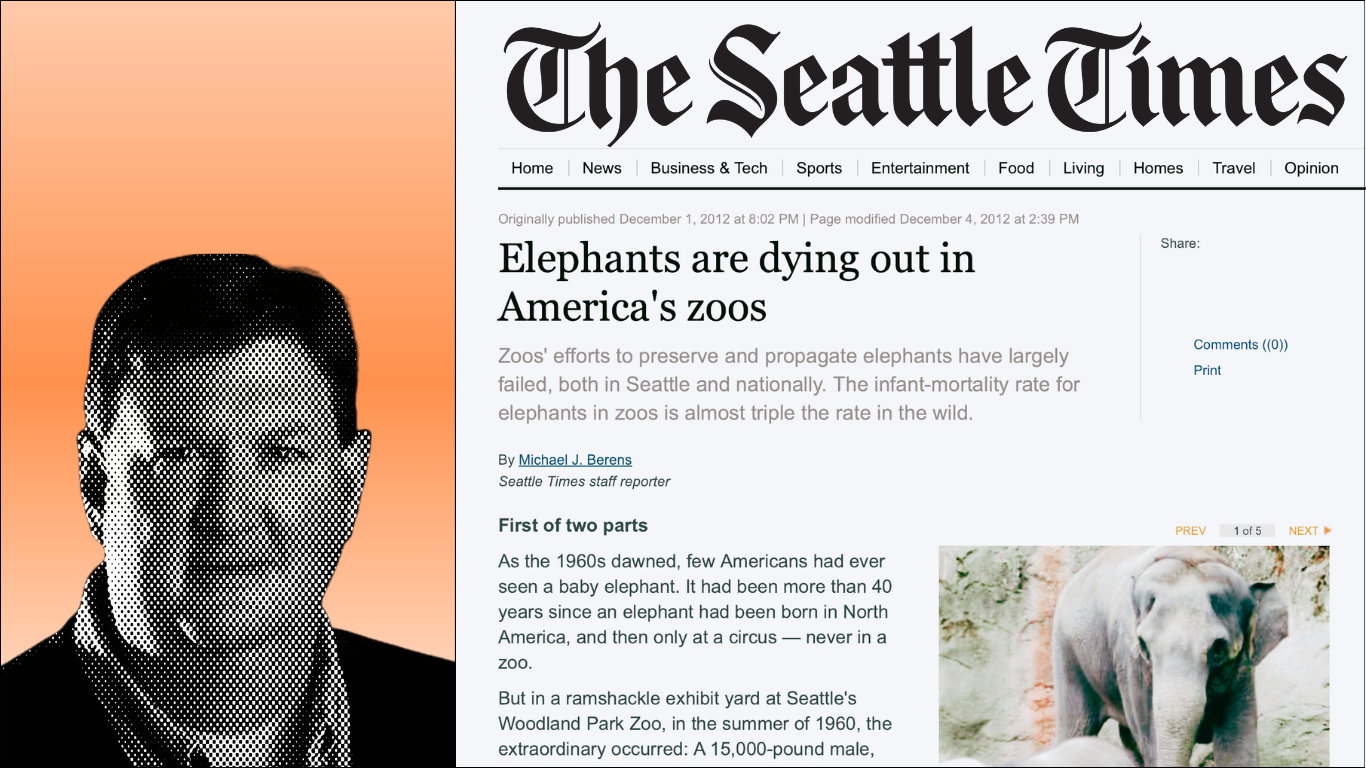
Then the journalist Michael J. Berens started pulling at the threads.
Berens wasn’t an activist, and he wasn’t writing from the margins. He was an investigative reporter at The Seattle Times with the kind of track record that makes institutions nervous for good reason. He won the 2012 Pulitzer Prize for Investigative Reporting with Ken Armstrong for an investigation into methadone prescribing in Washington State. He was a three-time Pulitzer finalist, and his work earned major national honors including the Worth Bingham Prize, the Selden Ring Award, and the Gerald Loeb Award.
So when Berens turned his attention to zoo elephants in late 2012, what followed mattered. His two-part Seattle Times investigation, Glamour Beasts, didn’t just challenge the zoo industry’s talking points. It exposed how badly the industry’s own story had drifted from reality.
The first installment, “Elephants Are Dying Out in America’s Zoos,” remains one of the clearest pieces of reporting published on elephant captivity in the United States. Berens reported that the zoo industry’s decades-long effort to preserve elephants in captivity was failing, and failing by its own numbers: for every elephant born in a U.S. zoo, on average, two others die. He also reported that while zoos publicly insisted elephants were “thriving,” internal population projections showed that, under existing conditions, elephants in accredited American zoos could be demographically extinct within 50 years.
It’s one thing to argue about welfare standards around the edges of captivity. It’s another thing entirely to discover that the central defense of elephant captivity — that zoos are somehow preserving the species — was breaking down under the basic math. If more elephants are dying than being born, and if the captive population is still heading toward collapse, then the conservation case is not merely problematic — it’s in crisis.
What made Berens’ reporting so powerful was that he didn’t leave those numbers floating in abstraction. He tied them back to the actual lives and bodies of elephants in zoos. He documented hundreds of elephant deaths in accredited U.S. zoos, found infant mortality in zoos to be nearly three times that seen in the wild, and linked many deaths to illnesses and conditions associated with captivity. The point wasn’t simply that the breeding program had fallen short; it was that the system was producing suffering while continuing to sell itself as success.
That alone would have made Glamour Beasts important. But the second part of the series made the deeper problem even harder to ignore. In “Elephant Havens Face Zoo-Industry Backlash,” Berens turned to sanctuary. If the zoo industry were truly guided by what was best for elephants, this should have been the easy part. Sanctuaries offered space, retirement, and an exit from the artificial demands of zoo breeding. They offered a way out, especially for elephants who were aging, ill, or exceptionally poorly served by zoo life.
Instead, Berens found that the Association of Zoos and Aquariums (AZA) treated sanctuaries as a threat. His reporting showed that AZA had adopted harsh punishments for zoos that chose to send elephants to sanctuaries, including measures designed to hurt those zoos financially. The reason was plain: sanctuaries refused to breed more elephants into captivity. That single fact cuts through years of euphemism. AZA was protecting access to a shrinking captive breeding population.
That is one of the most important insights in Berens’ work, and one that still doesn’t get nearly enough attention. Zoos didn’t just fail to prove that breeding elephants in captivity was helping the species. Through AZA, the industry also punished institutions that tried to step away from that model and place elephants somewhere breeding would stop. The system revealed its values by how it responded when elephants were removed from production.
That logic surfaced in one of the most astonishing details connected to Berens’ reporting: the Oregon Zoo contract. In a follow-up piece, The Seattle Times reported on scrutiny surrounding an agreement involving an Oregon Zoo elephant calf and the zoo’s insistence that the calf would remain there even if her mother died. Berens obtained a contract showing the calf was the legal property of Have Trunk Will Travel, a private company known for renting out elephants for weddings and film shoots, and later the subject of undercover abuse allegations involving electric prods and bullhooks. With an arrangement like that inside an AZA-accredited breeding program, it becomes much harder to pretend captive breeding is neatly divided between noble conservation on one side and commerce on the other.
The public response to Berens’ work showed that people understood the stakes. The series helped drive a citizen petition signed by thousands and generated enough pressure that Seattle city officials moved to examine Woodland Park Zoo’s elephant program. Woodland Park Zoo eventually announced it would phase out its elephant program.
But even that story ended in a way that illustrates the industry’s grip. Activists pushed to send Woodland Park’s elephants to the PAWS sanctuary, while the zoo instead transferred them to the Oklahoma City Zoo. Chai, one of those elephants, died at the Oklahoma City Zoo in January 2016 at age 37; she had undergone 112 artificial insemination attempts before her transfer. Even when the public conversation shifted, the system still worked to keep elephants inside the zoo network.
That may be the bleakest lesson in all of this. Institutions can absorb a shocking amount of criticism if they’re allowed to define “reform” on their own terms. They appoint task forces, narrow the questions, and cast critics as extremists. They present structural failure as an opportunity to improve practices incrementally, rather than reconsider the model itself.
Berens’ reporting mattered because it made it harder to do. He documented intense contradiction: zoos said elephants were thriving, but the numbers showed a population in decline. Zoos said breeding was about preservation; AZA punished zoos that chose sanctuary over reproduction. Accredited institutions wrapped themselves in the language of science and welfare, while the underlying incentives pointed somewhere else.
More than a decade later, Glamour Beasts still reads like essential work because the core problem it exposed has never been resolved. The zoo industry continues to rely on the same moral vocabulary — conservation, survival, stewardship, public education — even though Berens showed how misleading those claims were when tested against outcomes. If the public wants to understand why so many advocates are no longer persuaded by zoo breeding programs, Michael J. Berens’ reporting is one of the best places to start.
