
The Hidden Mortality Crisis in US Zoo Elephant Breeding Programs

Elephant calf Ollie at Columbus Zoo in Delaware County, Ohio. Photo: Columbus Zoo
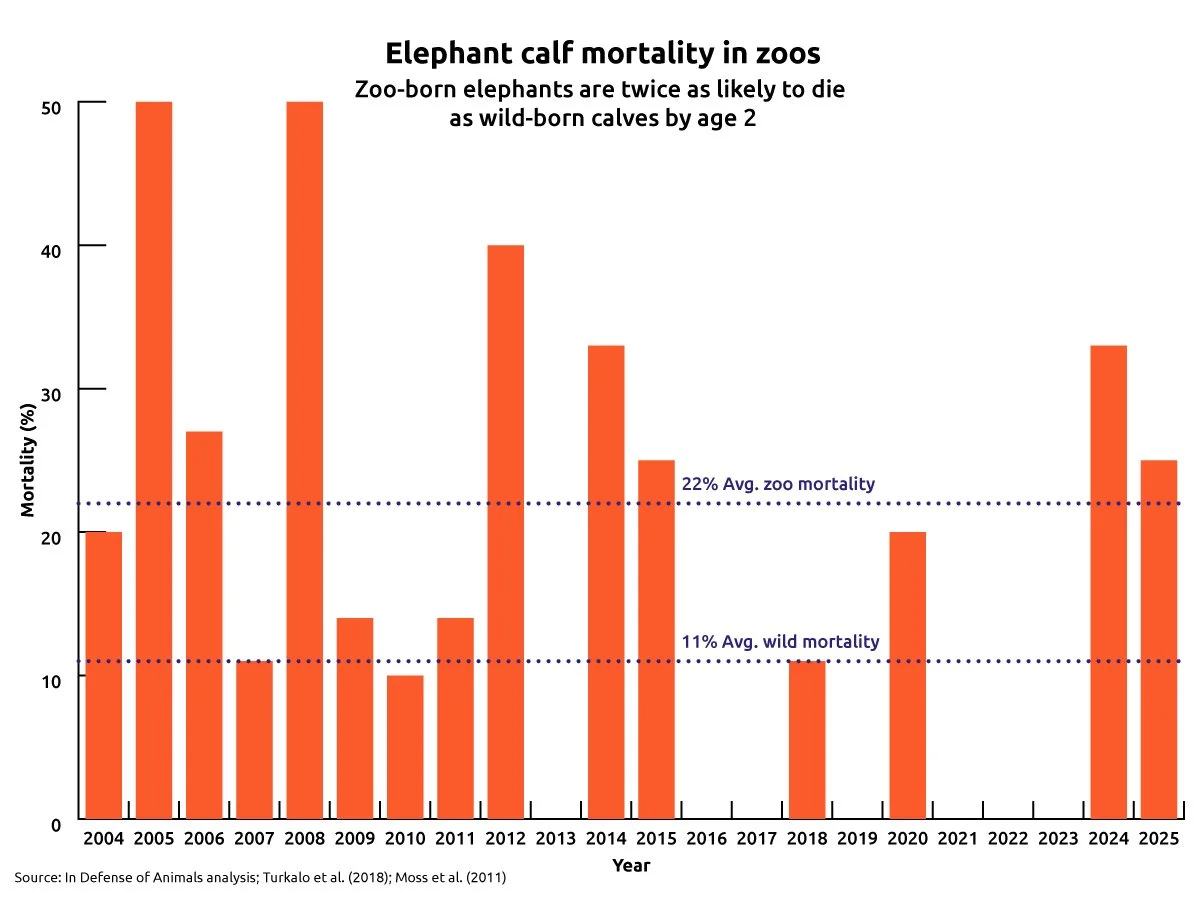
The numbers are devastating. One in four elephants born in North American zoos dies before reaching just age five — a rate double that of wild elephant calves. These zoo-born babies supposedly have every advantage: protection from drought, predators, and poaching. Instead, they are victims of a captive breeding industry driven by display value and profit — not genuine conservation.
New analyses by In Defense of Animals (IDA) show that since 2004, over one-third of all elephants born in North American zoos are already dead. In 20 of the last 21 recorded years, captive elephant deaths have equaled or exceeded births, meaning zoos are unable to sustain these populations without continually breeding more calves into harmful conditions. Despite this clear pattern of loss and suffering, the breeding continues — even accelerating, with 12 calves born in US zoos in 2025 alone.
Why are zoo‑born elephants dying?
Elephants are animals of staggering intelligence, emotional complexity, and social sophistication, with deep family bonds, rich cultures, and vast home ranges in the wild. No enclosure — no matter how “modern” — can replicate the space, freedom of choice, and social structures they require to thrive. This mismatch between elephants’ needs and what captivity can offer sits at the heart of the mortality crisis.
Zoo-born calves who survive past age five often face a lifetime of chronic illness and psychological distress. Independent studies and veterinary reports document high rates of arthritis, foot and joint disease, obesity, reproductive disorders, and stress-related behaviors such as swaying and head-bobbing. Even in facilities accredited by major zoo associations, these conditions are widespread, signaling a systemic welfare failure rather than a few “bad actors.”
“Zoo-bred elephants are fated to suffer from the moment they are conceived, and die at double the rate of wild babies. This industry is manufacturing babies in a bid to keep exhibits full — not to save elephants.”
- Dr. Marilyn Kroplick, President of In Defense of Animals
Captivity also harms elephants at the most intimate level: their family lives and social development. In the wild, calves grow up surrounded by mothers, aunties, siblings, and cousins, learning vital survival and social skills from a stable, multi-generational herd. In zoos, elephants are frequently shuffled between facilities to support breeding programs, separating mothers and offspring and disrupting bonds that would naturally last a lifetime.
The toll of invasive breeding
A separate report by elephant experts Dr. Rob Atkinson, Dr. Andrew Kelly, and Dr. Keith Lindsay explores how zoo breeding programs distort elephants’ biology and social lives. The authors describe how female elephants in captivity are routinely subjected to invasive artificial insemination procedures from as young as eight years old — years before most wild elephants are naturally ready to give birth. This early and repeated manipulation of their reproductive systems turns their bodies into instruments of display, rather than respecting them as sentient, autonomous beings.
These experts warn that the disruption caused by zoos to the sexual development of both male and female elephants produces “a population whose breeding, sexuality, and sociality bear no relation to that of wild elephants.” In other words, the elephants being created in captivity are not ambassadors of wild herds — they are products of an artificial system that breaks the very relationships and behaviors conservation should protect.
Manufacturing life they cannot sustain
IDA describes a “zoo baby boom” that has turned deadly, as institutions continue to promote elephant births as feel‑good stories while downplaying the grim statistics behind the headlines. Courtney Scott, Elephant Consultant for IDA, says that zoos are “manufacturing life they cannot sustain,” noting that over one-third of all elephants born in zoos since 2004 are already dead. The organization’s analysis shows that by age two, the death rate for elephant calves in zoos is double that of their wild counterparts, despite the absence of natural threats such as predators and poaching.
Dr. Marilyn Kroplick, President of In Defense of Animals, is blunt: “Zoo-bred elephants are fated to suffer from the moment they are conceived, and die at double the rate of wild babies. This industry is manufacturing babies in a bid to keep exhibits full — not to save elephants.” Her words cut through the illusion that breeding elephants in captivity is a form of conservation. When more elephants are dying than being born, when none are returned to the wild, and when their lives are marked by preventable suffering, the claim of conservation becomes impossible to defend.
Not a single elephant born in a North American zoo has ever been released back into the wild. These calves are born to live and die behind barriers, never knowing the landscapes or social worlds their species evolved to inhabit.
Profit over protection
Of course, baby elephants drive massive attendance and revenue spikes. When Woodland Park Zoo in Seattle bred a baby elephant, attendance rose 171% over the previous year and doubled winter projections. The Oregon Zoo saw attendance triple when a baby elephant was born, and later used a calf’s image to help pass a $125 million bond measure. Indianapolis Zoo’s elephant calves generated $10 million in donations in a single year, and Columbus Zoo saw record attendance following a calf birth.
The Houston Zoo is one of the starkest examples of this cycle of tragedy. According to IDA’s 2025 “10 Worst Zoos for Elephants” list, the facility has seen 25 Asian elephant calves born over the years — and 17 of them are now dead. IDA describes Houston’s program as “relentless,” with females pushed into unnaturally early and rapid breeding and subjected to invasive reproductive procedures.
These practices, IDA argues, are directly linked to shortened lifespans and devastating calf losses. The deaths are not random misfortunes; they are predictable outcomes of a system that prioritizes having baby elephants on display over meeting elephants’ physical and emotional needs. When zoos celebrate each new calf without acknowledging this context, the public is invited to celebrate a story that is, in reality, built on grief.
This isn’t conservation
True conservation protects wild animals in their natural habitats, preserves ecosystems, and addresses the root causes of population declines, such as habitat loss, conflict, and poaching. By these standards, elephant breeding in zoos fails on every front: it does not strengthen wild populations, it does not reintroduce elephants to their native ranges, and it consumes resources that could instead support in-situ protection and community-based consevation.
IDA and other advocates stress that the role of zoos should not be to manufacture more captive animals, but to phase out harmful programs and support strategies that keep elephants in the wild where they belong. As Kroplick puts it: “True conservation happens in the wild, not behind bars.”
There is another way
There’s a growing global recognition that elephants do not belong in captivity. More than 40 zoos have already shut down their elephant exhibits, acknowledging that they can’t meet the needs of these complex beings. Multiple otherszoos have agreed to phase out their elephant breeding programs over the coming years. At the same time, accredited sanctuaries have shown what a different model of care can look like: larger, more natural spaces; the opportunity to form or re-form social groups; choice over how and where to spend each day; and specialized veterinary and behavioral support tailored to elephants who have already endured trauma.
Sanctuary isn’t a perfect substitute for the wild, but for elephants who can’t be safely returned to their native habitats, it offers a path away from constant exhibition and exploitation. Instead of being bred and displayed, elephants at true sanctuaries are allowed to heal, explore, and reclaim some measure of autonomy and dignity.
The solution is clear:
Stop breeding elephants in captivity.
End invasive artificial insemination and forced reproduction programs.
Retire captive elephants to spacious, reputable sanctuaries.
Invest in protecting wild elephants and their habitats, where conservation truly belongs.
